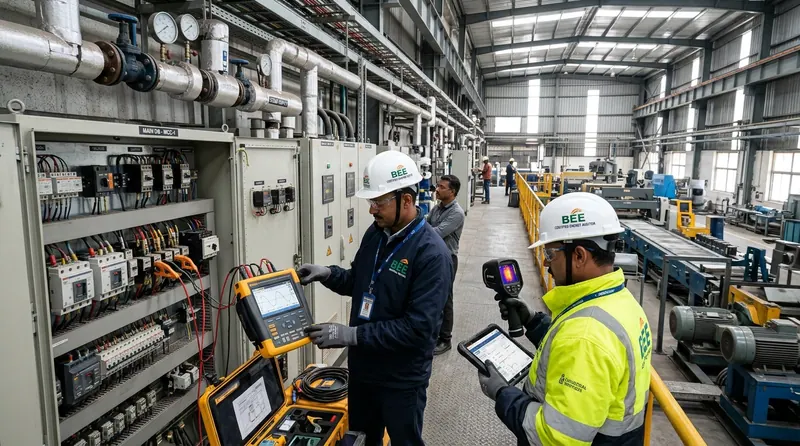
1. Legal Framework: EC Act 2001 & PAT Cycles
Under Section 14(a) of the Energy Conservation Act (EC Act) 2001, the Central Government has mandated that all commercial facilities and industrial plants falling within designated energy-intensive sectors and exceeding prescribed threshold consumption levels must undergo an official Mandatory Energy Audit by a Bureau of Energy Efficiency (BEE) Accredited Energy Auditor (AEA).
The Perform, Achieve and Trade (PAT) scheme represents India's flagship market-based mechanism under the National Mission for Enhanced Energy Efficiency (NMEEE). It operates in 3-year rolling cycles requiring each designated consumer to achieve specific reductions in their Specific Energy Consumption (SEC):
Statutory Citation:
*"Every Designated Consumer shall get energy audits conducted by an accredited energy auditor in the manner and intervals specified under BEE (Manner and Intervals of Time for Conduct of Energy Audit) Regulations."*
---
2. Designated Consumer (DC) Energy Thresholds
Industrial facilities operating in the following sectors are categorized as Designated Consumers when their annual total energy consumption equals or exceeds these statutory thresholds (measured in Metric Tonnes of Oil Equivalent - MTOE):
| Industrial Sector | Minimum Threshold (MTOE / Year) | Primary Energy Metrics |
| Thermal Power Plants (Coal/Gas) | 30,000 MTOE | Net Station Heat Rate (kCal/kWh) |
|---|
| Cement Mills | 30,000 MTOE | Specific Power (kWh/t) & Heat (kCal/kg clinker) |
|---|
| Iron & Steel | 30,000 MTOE | Giga Calories per Tonne of Crude Steel |
|---|
| Textile (Composite) | 3,000 MTOE | kWh per Kilogram of Finished Fabric |
|---|
| Pulp & Paper | 30,000 MTOE | Tonnes of Steam & kWh per Tonne of Paper |
|---|
| Commercial Buildings (DISCOM) | 100 kW / 120 kVA connected | Energy Performance Index (kWh/sq.m/yr) |
|---|
---
3. The 4-Phase Statutory Audit Protocol
When Athul Energy's team of Accredited Energy Auditors executes a mandatory audit, the process is structured into four non-negotiable engineering phases:
Phase 1: Pre-Audit Single-Line & Billing Harmonization
Phase 2: Live On-Site Precision Field Logging
Phase 3: Mass & Energy Balance Mathematical Modeling
Phase 4: Energy Conservation Measures (ECM) & Payback Roadmap
---
4. Form 1, Form A/B Filing & Statutory Reporting
Once field measurements and modeling are completed, the Designated Consumer must submit official compliance documentation to both the State Designated Agency (SDA) (such as EMC Kerala or MEDA) and the Bureau of Energy Efficiency (BEE):
1. Form 1: Annual energy consumption details, fuel inventory, production logs, and specific energy consumption metrics. Must be submitted within 3 months of the financial year close. 2. Form A (Audit Report Certification): Official sign-off by the BEE Accredited Energy Auditor certifying that the audit was conducted according to statutory codes. 3. Form B (Action Plan Implementation): Details of the energy conservation recommendations implemented by the DC and verified savings achieved.
Failure to submit Form 1 or conduct audits within prescribed intervals attracts statutory penalties under Section 26 of the Energy Conservation Act, with daily fines for ongoing non-compliance.
---
5. Monetizing Compliance via ESCerts (Trading)
One of the most powerful financial incentives in the PAT framework is the Energy Saving Certificate (ESCert) mechanism:
---
6. Plant Manager Audit Readiness Checklist
To ensure your facility is prepared for an accredited BEE audit with zero friction, keep the following documentation organized: