Govt. accreditedEMC Kerala / BEE / GEDAEnergy · Safety · Sustainabilitysince 2008
+91 73561 11990info@athulenergy.com
Athul Energy Consultants
Home
About
Company Profile & StoryWho we are, BEE & EMC empanelments, and 15+ years of audit history since 2008.Our Engineering TeamBEE Accredited Energy Auditors, CEA Safety Inspectors, FLIR Thermographers & Green specialists.
Services
Energy AuditsDetailed electrical, thermal, PAT M&V and mandatory BEE/EMC statutory assessments.Safety AuditsCEA regulation compliance, arc flash analysis, fire safety and IS 14489 hazard reviews.Thermography & SurveysFLIR Level-II thermal scanning, ultrasonic flow testing and IS 3043 earthing studies.Compliance & NAACGRIHA green building audits, NAAC criteria 7, NABH hospital safety and ISO 50001.Technical TrainingBEE exam coaching, industrial electrical safety, LOTO protocols and engineer workshops.All 30+ Services HubExplore complete directory with live keyword search, standards and instrument specs.
30+ Disciplines · BEE Accredited & EMC EmpanelledBrowse full directory
GalleryBlogContact
Request an audit
Home
GalleryBlogContact
Call usRequest an audit
Athul Energy Consultants

BEE accredited energy audit and electrical safety consultants serving industrial, commercial and institutional sites across Kerala since 2008.

BEE AEA-0275EMC KeralaGEDAMEDA
+91 73561 11990Email us

Company

  • About us
  • Engineering team
  • Downloads
  • Gallery
  • News & events
  • Contact

Services

  • Energy Audits
  • Safety Audits
  • Thermography & Surveys
  • Compliance & NAAC
  • Technical Training
  • All 30 services

Head office

Capital Legend Building,
Korappath Lane, Thrissur North,
Kerala 680020

+91 73561 11990

info@athulenergy.com

© 2026 Athul Energy Consultants Pvt. Ltd. All rights reserved.

BEE accredited · Est. 2008Request an audit
HomeBlogInfrared ThermographyInfrared Thermography in Predictive Maintenance: Detecting Busbar & Bearing Hotspots Early
Infrared ThermographyOctober 10, 2026•6 min read

Infrared Thermography in Predictive Maintenance: Detecting Busbar & Bearing Hotspots Early

How non-contact thermal scanning with calibrated FLIR cameras prevents catastrophic switchgear failures, transformer bushing degradation, and motor bearing burnouts.

DV
Dinil VasanLead Thermographer & Condition Monitoring Engineer
FLIR Level-II Certified
Infrared Thermography in Predictive Maintenance: Detecting Busbar & Bearing Hotspots Early
Field Study Dossier · Athul Energy ConsultantsNABL Calibrated Instrumentation
Key Statutory Takeaways for Plant Managers
  • Mandatory compliance intervals must be adhered to avoid Section 26 fines under the Energy Conservation Act 2001.
  • All baseline SEC and electrical safety reports require direct sign-off by a BEE Accredited Energy Auditor.
  • Third-party verified NABL instrument calibration is legally required for Form 1 and Form A/B verification.

1. Why Predictive Thermography Matters

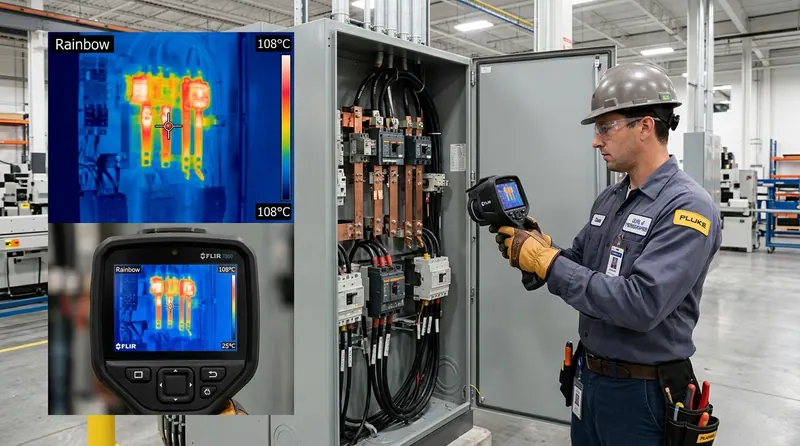
Every electrical and mechanical failure is preceded by abnormal heat generation. Before a busbar joint fuses, an insulated cable melts, or a bearing seizes, the junction temperature rises significantly above ambient levels due to increased electrical resistance ($P = I^2R$) or mechanical friction.

Infrared Thermography allows certified engineers to inspect live electrical installations and rotating equipment under full operational load without interrupting factory production.

---

2. The Delta-T (ΔT) Severity Matrix

Thermal scanning is not just about capturing pretty false-color pictures; it requires scientific quantification of temperature differences ($Delta T$). Athul Energy utilizes the standardized ASTM E1934 / NFPA 70B severity criteria:

Severity LevelTemperature Rise ($Delta T$) Above BaselineRecommended Corrective Action

Minor (Advisory)1°C to 10°CRepair during next scheduled maintenance shutdown.
Moderate (Intermediate)11°C to 20°CSchedule inspection and maintenance within 7 to 14 days.
Critical (Serious)21°C to 40°CUrgent maintenance required within 24 to 48 hours.
Emergency (Danger)> 40°CImmediate intervention required. High risk of flashover, insulation melt, or fire.

---

3. Electrical Switchboard Inspection Protocols

For an infrared scan to be valid, the following electrical conditions must be observed:

  • Minimum 40% Electrical Loading: Scans conducted at light loads (e.g. during lunch break or weekend standby) produce misleadingly low thermal gradients because heat dissipation scales with the square of current ($I^2$).
  • Direct Line of Sight: Infrared radiation does not pass through solid metal doors or standard Plexiglas covers. Panels must be safely opened or equipped with certified IR Windows (Calcium Fluoride or Germanium optics).
  • Emissivity Calibration: Setting the correct emissivity ($epsilon$) on the thermal imager (typically 0.95 for painted metal and PVC insulation, 0.20 to 0.40 for bare oxidized copper busbars).
  • ---

    4. Mechanical Thermography: Bearings & Couplings

    Beyond electrical panels, thermal imaging provides indispensable insights for mechanical equipment:

  • Motor Bearings: Detecting inadequate lubrication, over-greasing, or misalignment between motor and pump shafts.
  • Steam Traps: Verifying whether steam traps are blown open (wasting live steam) or plugged cold (causing condensate backup and water hammer).
  • Furnace Refractory Walls: Identifying refractory brick erosion and hot gas leaks on industrial kilns and boilers.
  • ---

    5. Best Practices During an Infrared Survey

    1. Conduct surveys at peak production hours when transformers and switchgear carry maximum current. 2. Pair every thermal radiograph with a standard digital photograph for exact component identification. 3. Record ambient temperature, relative humidity, and operating current on the report. 4. Verify hot spots using contact surface pyrometers to cross-reference optical emissivity.

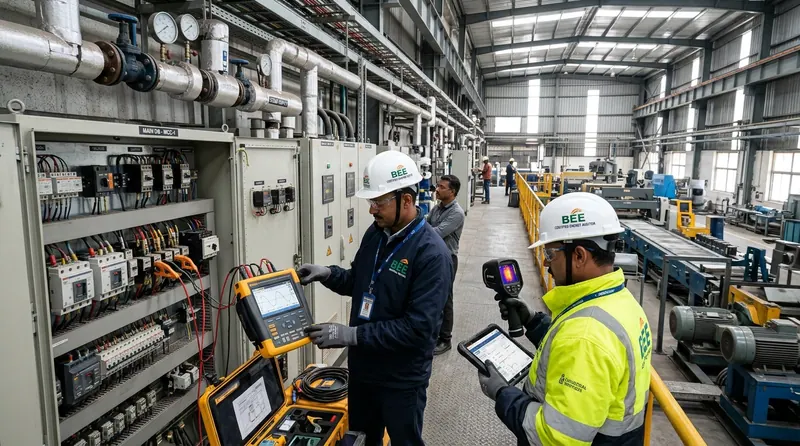
    Athul Energy deploys NABL-calibrated Level-II FLIR cameras with high spatial resolution to deliver comprehensive thermal inspection dossiers.
    Related Engineering Tags:
    #Thermography#FLIR Level-II#Predictive Maintenance#Hotspot Detection#ISO 18434-1
    DV
    Article Author & Technical Auditor

    Dinil Vasan

    Lead Thermographer & Condition Monitoring Engineer

    ITC Certified Level-II Thermographer with a focus on non-destructive condition monitoring across industrial substations, paper mills, and continuous process plants.

    Related Technical Guides

    View all insights →
    Complete Guide to Mandatory BEE Energy Audits for Designated Consumers (PAT Scheme)
    BEE Energy Audits
    8 min read
    BEE Energy Audits
    Oct 28, 2026

    Complete Guide to Mandatory BEE Energy Audits for Designated Consumers (PAT Scheme)

    A technical walkthrough for plant managers and electrical heads on compliance under the Energy Conservation Act 2001, Form 1 filings, SEC baseline benchmarking, and ESCerts trading.

    Santhosh A.•Oct 28
    SA
    Santhosh A.Lead BEE Accredited Energy Auditor (AEA-0275)
    Read Guide
    Table of Contents
    1. Why Predictive Thermography Matters2. The Delta-T (ΔT) Severity Matrix3. Electrical Switchboard Inspection Protocols4. Mechanical Thermography: Bearings & Couplings5. Best Practices During an Infrared Survey
    Empanelled Firm

    Schedule a Facility Audit

    Need assistance with BEE statutory audits, electrical safety sign-offs, or power quality mitigation?

    Request Audit Scoping+91 73561 11990
    NDA Assured:Plant single-line diagrams and utility bills are handled strictly under non-disclosure agreements.